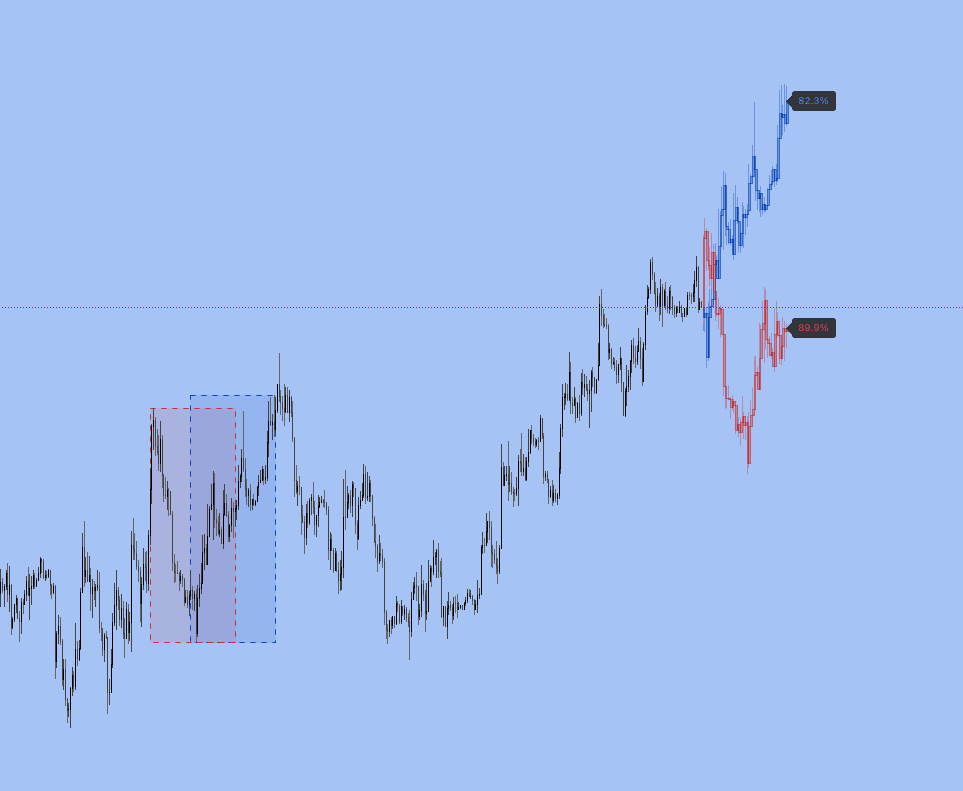
Markets rhyme. Historical price patterns repeat because market participants react to similar conditions in similar ways. Analogue Forecast PRO leverages this principle by scanning historical data for patterns that closely match the current price structure, then projecting the most probable forward path based on what happened after those historical analogues.
With a dedicated video walkthrough, Analogue Forecast PRO gives you a data-driven forecast that goes beyond traditional indicators — instead of telling you what happened, it tells you what is statistically likely to happen next.
How Analogue Forecast PRO Works
Pattern Matching Engine
The indicator analyzes the current price structure — the shape of recent price action over a defined lookback window — and searches historical data for the closest matching patterns. The matching algorithm evaluates:
- Shape similarity — how closely the historical pattern mirrors the current structure in terms of relative highs, lows, and momentum
- Volatility context — matches are weighted by similar volatility environments to improve relevance
- Time scaling — accounts for patterns that occurred over different absolute time spans but share the same proportional structure
- Correlation scoring — each match receives a correlation score so you can evaluate the quality of the analogue
Forward Projection
Once the best historical analogues are identified, the indicator projects the forward path by analyzing what price did after those historical patterns. The projection includes:
- A primary forecast path (the median outcome across top analogues)
- A confidence range based on the dispersion of historical outcomes
- Individual analogue paths for detailed comparison
Understanding Analogue Forecasting
Analogue forecasting is not prediction — it is statistical inference. The forecast shows what is most likely based on historical precedent, not what will definitely happen. The value lies in:
- Bias direction — when most analogues point in the same direction, the historical weight of evidence favors that outcome
- Timing context — analogues can suggest when a move is likely to occur, not just the direction
- Scenario planning — even when analogues diverge, they map out the most probable scenarios for your risk management
Trading Strategies
Strategy 1: Directional Bias
Use the analogue forecast as a directional filter. If the majority of analogues project upside over the next 10–20 bars, focus on long setups. If they project downside, focus on shorts or stay flat. Then use other EXCAVO indicators — like Liquidity Sweep PRO or Supply & Demand Zones PRO — for precise entry timing.
Strategy 2: Confluence with Technical Analysis
When the analogue forecast aligns with technical signals from Adaptive Supertrend (trend direction), Structural Flow PRO (structural levels), or Confluence Engine PRO (multi-factor scoring), the resulting confluence provides a multi-dimensional view that combines historical precedent with real-time technical confirmation.
Strategy 3: Risk Management and Scenario Planning
Even when you don't trade the forecast directly, use it for scenario planning. If analogues suggest a potential pullback in 5–10 bars, you might tighten stops on existing positions or reduce exposure. The forecast provides forward-looking context that pure technical analysis lacks.
Important Considerations
Analogue forecasting is a probabilistic tool, not a crystal ball. Key guidelines for effective use:
- Higher correlation scores indicate stronger pattern matches — prioritize these
- When analogues converge on a similar outcome, conviction is higher
- When analogues diverge significantly, the current structure may be ambiguous — reduce position size or wait for clarity
- Always combine the forecast with real-time price action and other technical tools
For more on validating indicator performance and understanding statistical edge, see our backtesting guide.
Best Markets and Timeframes
- Crypto — BTC and ETH have sufficient history for robust analogue matching. Crypto's cyclical nature (halving cycles, altcoin seasons) makes pattern matching particularly insightful
- Forex — major pairs have decades of data for deep analogue pools. Seasonal patterns and macroeconomic cycles create repeating structures
- Stocks and indices — the most data-rich markets. SPY and QQQ analogues can draw from decades of intraday and daily data
Recommended timeframes: Daily for the most robust forecasts with deep historical data. 4H for medium-term swing trade context. Weekly for macro-level market cycle analysis. Lower timeframes work but produce noisier matches.
All EXCAVO PRO indicators are included in one $39/month subscription — no tiers, no upsells.